Category: Top Posts

  • How to Replicate Vanguard Personal Advisor Services Investments and Save Money Every year

    I want to show you how to replicate the Vanguard Personal Advisor Services investments with another Vanguard offering, possibly saving you thousands of dollars per year.

    There is a certain allure to the Personal Advisor Services because Vanguard will invest your money in Vanguard funds and take care of the hassle of maintaining your portfolio at your recommended asset allocation.  When you sign up for the service, you will take a risk tolerance questionnaire, and Vanguard will determine the correct allocation for you after taking your goals into consideration.  After signing up, there is no work left for you to do, Vanguard will take care of the ongoing investment management.

    Before you rush off to sign up, let’s take a look at some of the fine print in the Vanguard personal advisor services brochure.
     

    (page 2, right column)


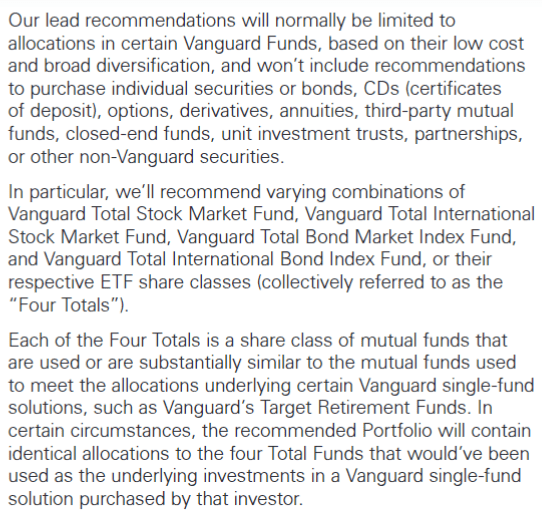
    Paragraph 1: “Our lead recommendations will normally be limited to allocations in certain Vanguard funds.”  That’s obvious.  Of course they will put your money in Vanguard funds, so no surprise there.


    Paragraph 2: the details of which Vanguard mutual funds will be used by the Personal Advisor Services are laid out right in front of you.
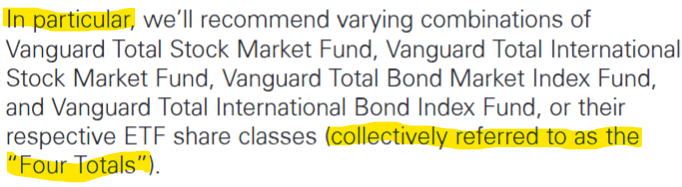
    So, your Personal Advisor Services allocation may / will be composed of 4 funds: The Vanguard Total Stock Market Fund, Vanguard Total International Stock Market Fund, Vanguard Total Bond Market Index Fund, and Vanguard Total International Bond Index Funds.  This is especially true if you are investing cash with the Vanguard advisor services, as opposed to turning over a portfolio of funds you already own.


    Paragraph 3: they lay out exactly how you could copy the service.
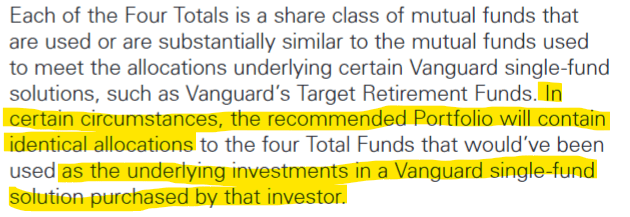
    They state, “each of the four totals …are substantially similar to the mutual funds used to meet the allocations underlying certain Vanguard single fund solutions”. In other words, there are mutual funds at Vanguard that are comprised of these four funds.


    As we continue reading this third paragraph of fine print here’s the real kicker: “In certain circumstances, the recommended portfolio will contain identical allocations to the Four Total funds that would have been used as the underlying investments in a Vanguard single-fund solution”. Oh my.

    Vanguard just told us that their Personal Advisor Services will be or may be an exact replica of a single fund that is already available at Vanguard.

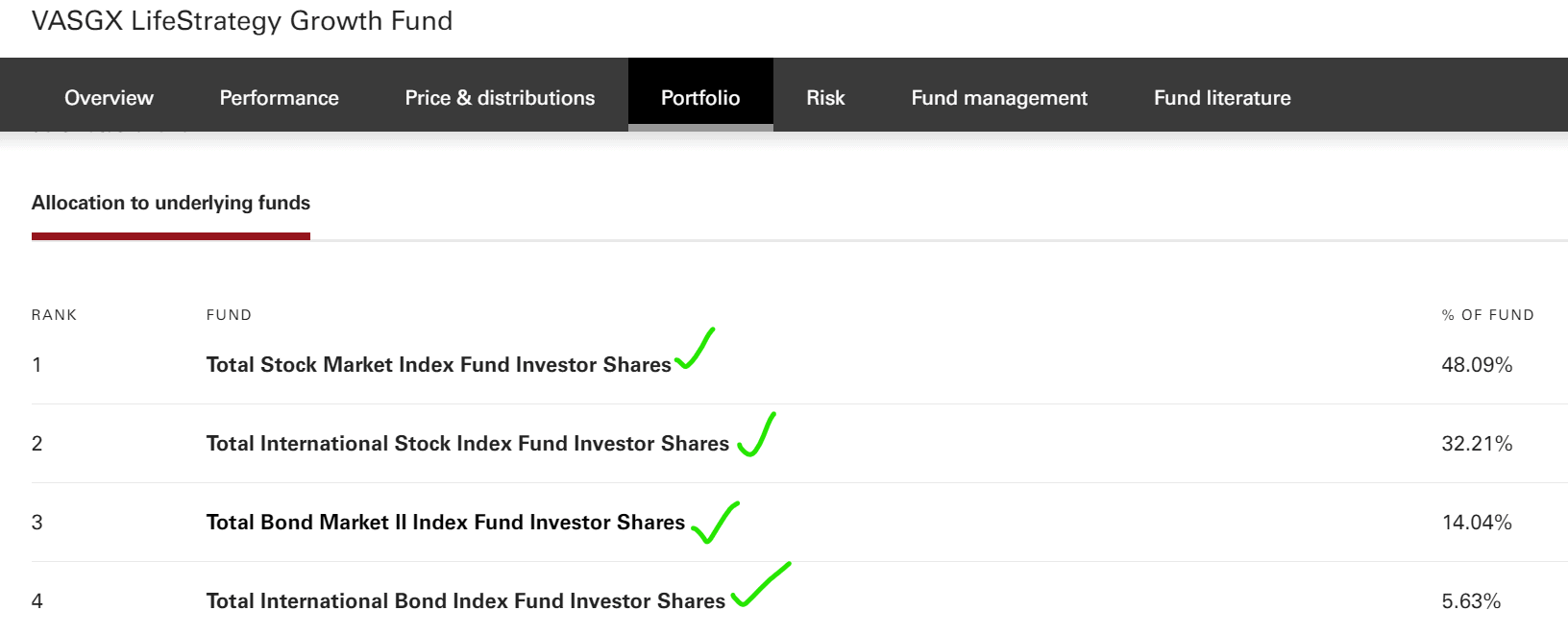
    I found these single funds that replicate the Personal Advisor Services.  They are named Vanguard LifeStrategy funds.


    Vanguard LifeStrategy funds

    There are four LifeStrategy mutual funds which are comprised of various combinations of the big Four Total funds (Vanguard Total Stock Market Fund, Vanguard Total International Stock Market Fund, Vanguard Total Bond Market Index Fund, and Vanguard Total International Bond Index Funds).  The LifeStrategy funds come in various target allocations.

    1. Income fund (VASIX) – allocation of 20% stocks & 80% bonds.
    2. Conservative growth fund (VSCGX) – 40% stocks & 60% bonds.
    3. Moderate growth fund (VSMGX) – 60% stocks & 40% bonds.
    4. Growth fund (VASGX) – 80% stocks and 20% bonds.

    The characteristic that makes these funds a replacement for the Vanguard Personal Advisor Services is the fact that they automatically rebalance the four holdings within them to keep the allocation at the desired level.  The ongoing management is done for you, by the fund, not by a manager for an additional fee.

    Handing off the hassle of rebalancing their investments is a major reason why people (especially retirees) sign up for the Personal Advisor Services.  Instead, they could buy a LifeStrategy fund.


    Cost Savings

    The Vanguard Personal Advisor Service charges 0.30% of the amount you have invested each and every year.  That means for a $500,000 investment, you will pay Vanguard $1,500 to manage your investment for you.  That is in addition to the fund fees which range from (0.04% to 0.11% annually).

    If you open a Vanguard account and buy a LifeStrategy fund, you will pay only the LifeStrategy fund fees (0.11% to 0.14% annually).

    Let’s compare the fees a retiree with a $1,000,000 account will pay each year.

     

    Chart of savings from Vanguard LifeStrategy fund over Vanguard Personal Advisor Services


    Using the LifeStrategy funds will save you more than $200 per month.

    An additional option is to use this savings to get annual financial planning improvements from an independent financial planner like Andrew Marshall Financial, LLC.  We give clients objective advice that considers all aspects of their life, not just the accounts invested at one company.  We can help you set up your Vanguard accounts to use LifeStrategy funds and much more.  Click here to set up a free video call.
     

    Finally, click here to read an additional review of Vanguard Personal Advisor Services from Adviceonlyfinancial.com


  • What is a Pension Worth?

    In this post I am going to show you a method for calculating your pension value. 

    You can use these calculations to determine how much you would need in a retirement account (401(k)/403(b)/IRA) to safely withdraw an amount equal to your pension income.

    The research behind the calculations comes from an article published in the Journal of Financial Planning, November 2018 issue.  The article was titled “Annuitized Income and Optimal Equity Allocation”. 

    You can watch a video version of this post on Youtube by clicking here.

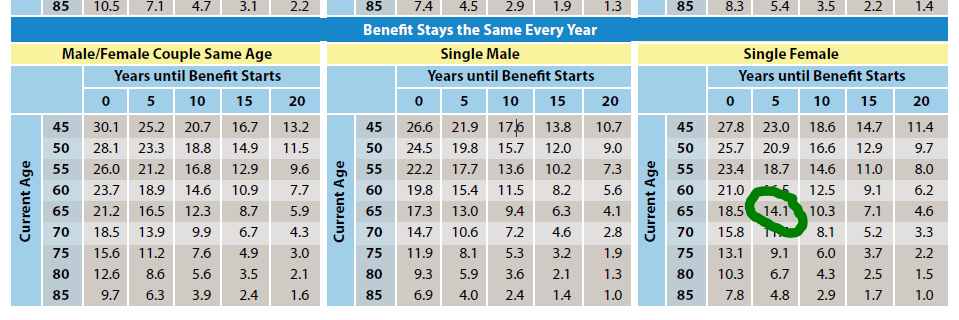
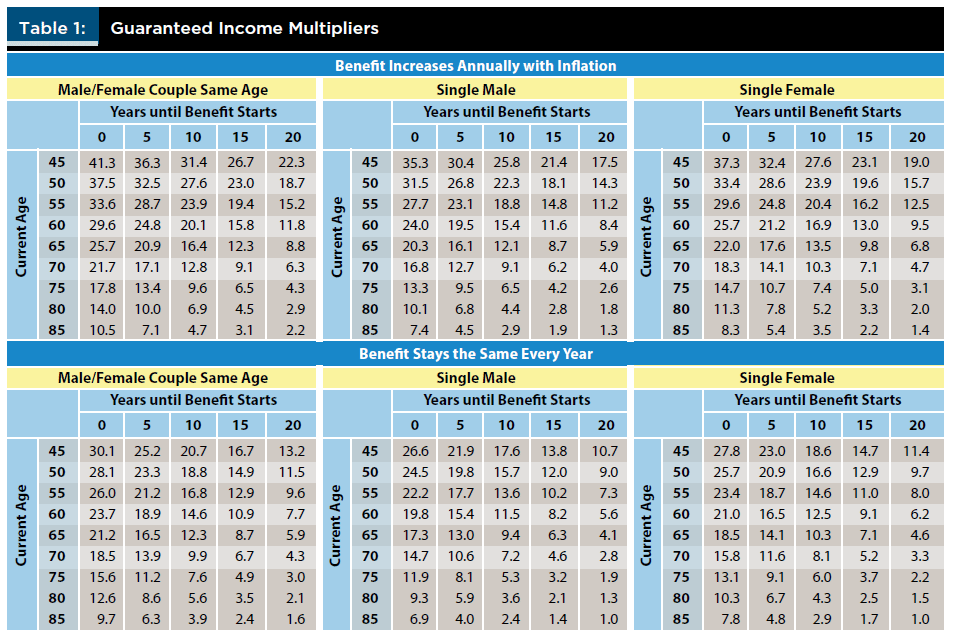
    Here is the Income Multiplier chart from the research article: 


    In our first example, a pensioner receives $77,000/ year and that pension income increases with inflation.  This pensioner is 70 years old, and his wife is of similar age. 

    Since his pension has a cost-of-living increase, we are using the top row of three results in the chart.  His pension has already started so we will use column “0”.  We find his multiplier is 21.7. 


    To calculate his pension’s value, we take his annual pension income and multiply it by 21.7.   

    $77,000 x 21.7 $1,670,900 !! 

    So, for this couple to confidently withdraw an inflation adjusted $77,000 annually for the rest of their lives, they would need to have an additional investment account with $1.67 million in it! 


    Let’s look at two other examples and calculate how valuable their pensions are. 


    Next, we look at a firefighter captain who is retiring at age 55.  His pension is $85,000.  He is unmarried and so we will use the single male chart in the middle of the top row. 

    From the chart, we find his multiplier is 27.7. 

    Calculating the value of his pension means $85,000 times 27.7 for a total of $2,354,500 !! 

    This gentleman would have needed to have a high paying job to have accumulated $2.3 million by the age of 55!  Instead, he risked his life and survived with a guaranteed income stream. 


    Not all pensions are large.  Some will cover only a small portion of your expenses in retirement.  For example, a lady had worked in the grocery industry when she was younger.  She was entitled to a pension of $9,000 per year with no inflation increase, ends upon her death, and starts five years from now.  She is currently 65 years old. 

    How much would an equivalent savings amount be? 


    From the chart above, we find her multiplier.  It is 14.1. 

    $9,000 x 14.1 = $126,900! 


    From these examples, you can see that a pension is an extremely valuable asset.   

    It would take many years of saving and successful investing to accumulate an equivalent amount. 


    Contact Andrew Marshall Financial, LLC today to talk about your pension, retirement, or other financial planning needs. 

  • Sample Financial Plan

    What does a financial plan look like? (Updated 2022)

    In this blog post I am going to show you highlights of a sample financial plan for a couple approaching retirement.

    Each section of a financial plan from Andrew Marshall Financial, LLC includes a written discussion of the topic, my recommendation for your best course of action, the reasoning behind that recommendation, and data, diagrams, or other evidence to support the recommendation.

    I am not going to show an entire financial plan here.  In a financial plan, the discussion of each section can be extensive.   This sample retirement plan was 13 pages when printed. 

    This post should still give you a good idea for what to expect when you hire us to create your financial plan.


    Not Mike or Susan

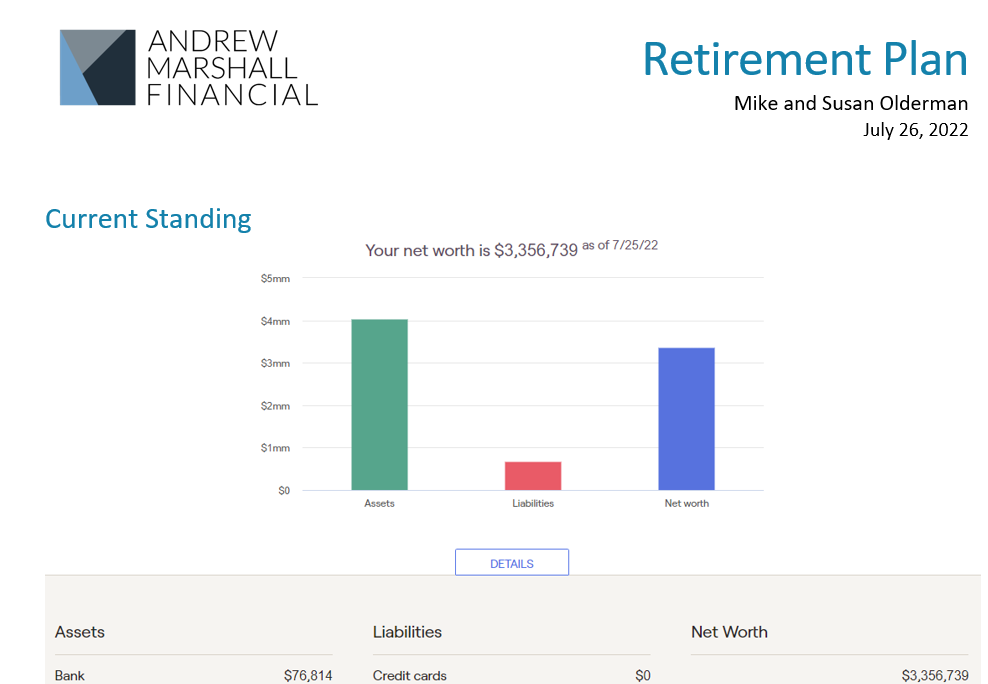
    The sample financial plan we are going to look at here is for two clients named Mike and Susan.   

    Mike and Susan are baby boomers with two grown children who no longer require their support Susan has just retired from Kaiser Permanente and Mike is still working. 

    Mike and Susan have been managing their finances on their own, but with retirement approaching, they want a professional opinion to confirm they can retire as expected and to make sure they are not missing something they are unaware of.

    Let’s go through some highlights of their financial plan.  


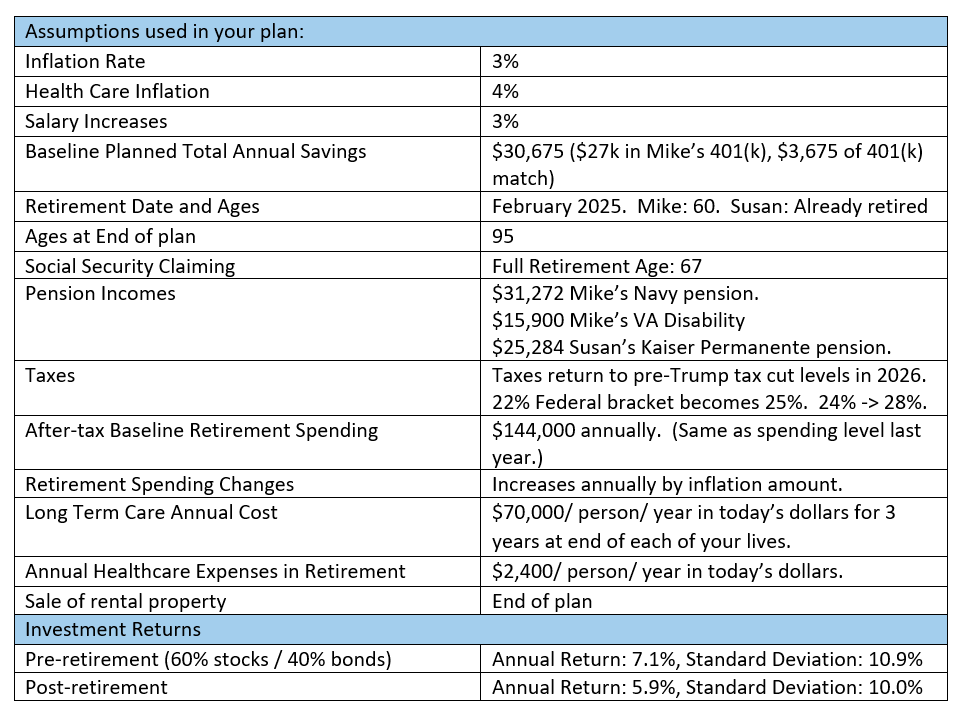
    After looking at where they currently stand, we review some assumptions used in the financial plan.

    Assumptions are an integral part of any financial plan.  We must assume certain inflation rates, investment returns, savings amounts, life expectancy and others to be able to do the necessary calculations. 

    Those assumptions are laid out near the beginning of the plan, so they are known to all. 


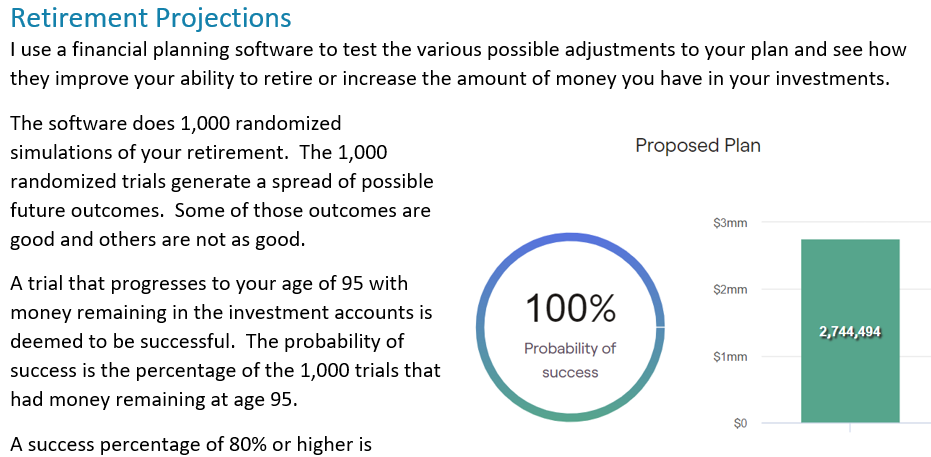
    Our financial planning software does Monte Carlo analysis to project the probability of success in the future.  In financial planning terms, this is the chance that you will still have money remaining in your investment accounts at age 95, with the assumptions above.


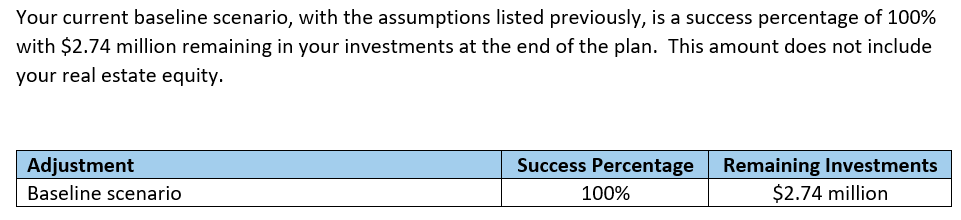
    Using the assumptions and the software, we come up with a baseline scenario.  For Mike and Susan the outcomes are excellent.


    From here we can test various options and changes to what they are currently doing to maximize their retirement outcomes in terms of success percentage and ending assets.

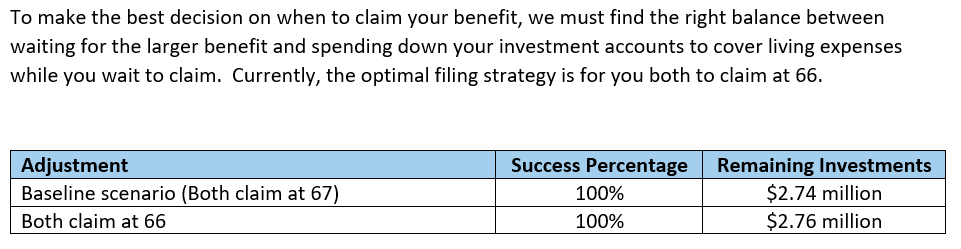
    The first topic is a discussion of Social Security claiming strategies and how those strategies impact the retirement plan.


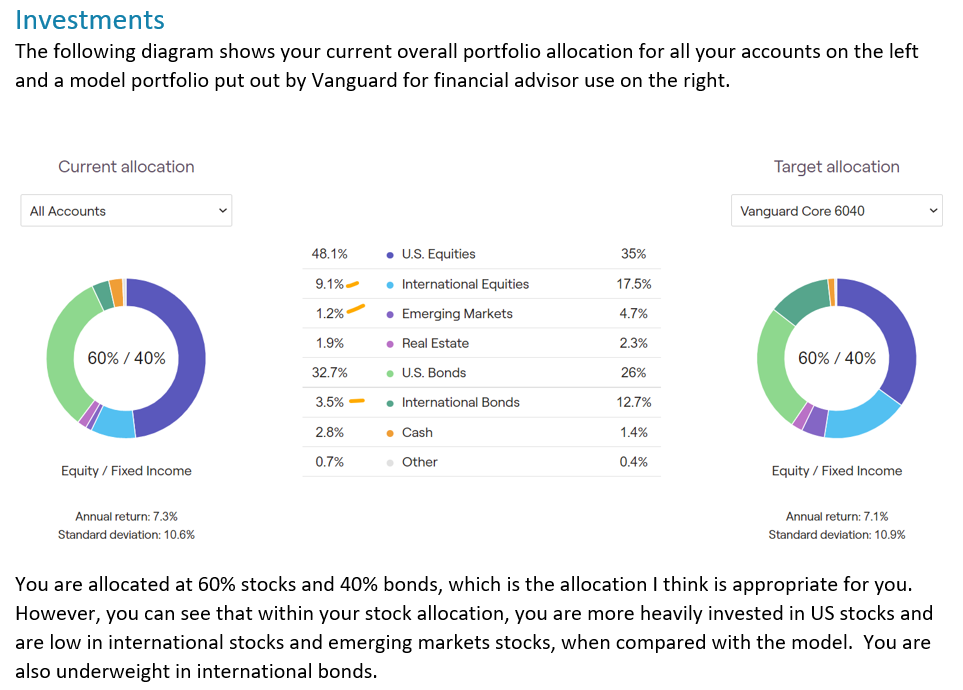
    Every plan has a section covering investment review and analysis. 


    If you have multiple investment accounts like IRA’s, Roth IRA’s, 401(k)‘s, taxable accounts, and others, then I will review all of your accounts and create a cohesive plan that optimizes each account.  A discussion of each account and the recommended adjustments is included.  If selling and buying of funds are recommended, they are listed out by fund, amount, and account, to make it as easy as possible to implement the adjustments.


    This sample plan includes a discussion of Susan’s pension options.  This was a long, multiple page section explaining the risks and benefits of each option.


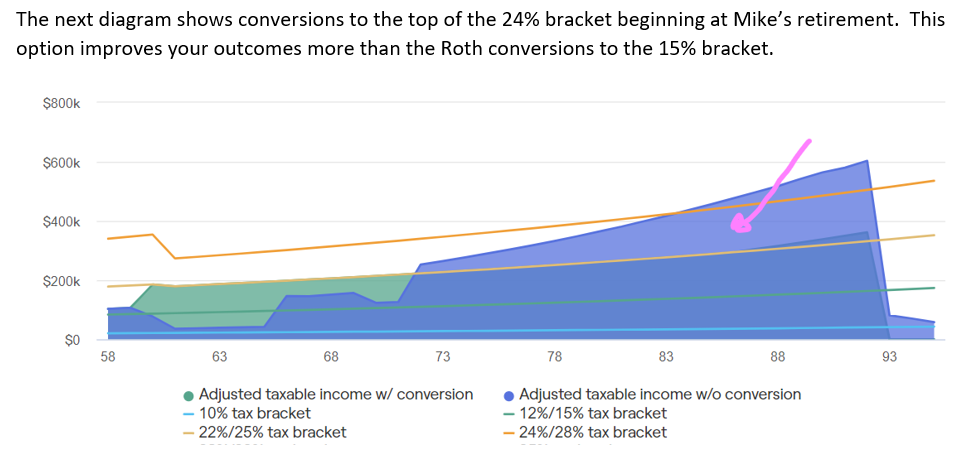
    There is also a discussion about Roth conversion strategies and a chart showing how conversions would improve their retirement outcomes.


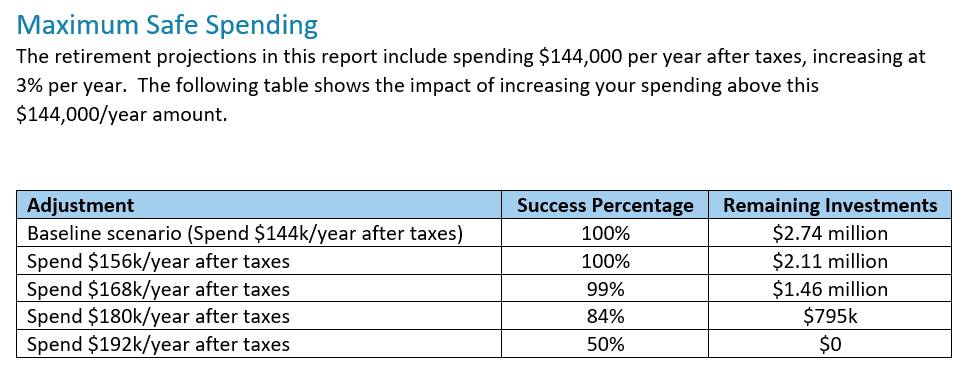
    A popular topic is what is the maximum safe spending possible in retirement.  The following graphic shows the impact of Mike and Susan increasing their spending in retirement.


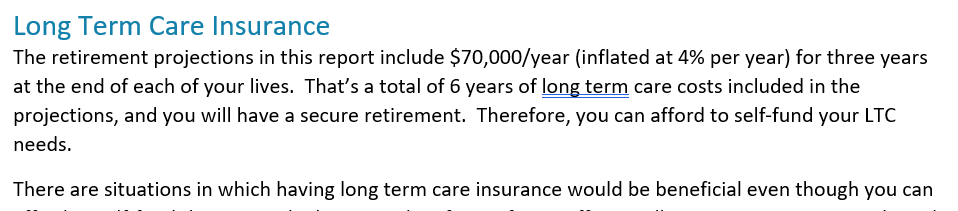
    Finally, they were interested in long term care insurance.  A discussion of the risks, a quote for long term care insurance, and a review of whether they can self-fund are included.


    The culmination of all the analysis and discussions in this example financial plan is the creation of a written retirement plan that Mike and Susan can use to implement the changes and refer back to as needed.


    The topics covered in your financial plan will likely be different from this sample retirement plan.  Your topics are decided upon when we first meet.

    Additional topics you may be interested in include:

    • what account is best to save money in,
    • how should you withdraw from your accounts once you retire,
    • a review of your tax return,
    • stress testing the success percentage,
    • including a reverse mortgage at retirement,
    • should you pay off your mortgage early,
    • do you need to keep your life insurance policies,
    • and many others.


    As for future updates to your plan, I leave it up to you.  I would recommend Mike and Susan update their financial plan each year to make sure they stay on track to retire.  For an update, we will repeat the process of deciding what work you need done, generating a quote, signing a contract extension, and then doing the work.


    If you would like to talk about creating your financial plan, call (760) 651-6315 or schedule your first meeting. 

  • Living Off Your Money in Retirement

    Living Off Your Money in Retirement

    The Best Method for Managing Your Own Retirement Investment Portfolio


    Your investment portfolio during retirement must be able to handle several issues. 

    1. It must allow for withdrawals sufficient to cover your lifestyle 
    2. It must increase enough to overcome inflation 
    3. It must not sell stocks when the market is down 
    4. It must have safe investments, so your money is there when you need it 

    These four tasks can sound difficult, but there is a method which can achieve them.


    The ideas described in this blog post come from a book titled “Living Off Your Money” by Michael H. McClung.  I was very excited to read this book because it solves one of the great misconceptions I think exists in financial advice. 

    That misconception is the idea that account rebalancing is helpful to client account size.  It is not.  The Living Off Your Money book details a better way to manage a retirement portfolio. Mr. McClung’s new strategies are named Prime Harvesting and Alternate Prime Harvesting.  They are very similar, just the amount of stocks that are sold is different.  Both improve on typical rebalancing. 


    Typical Account Rebalancing 

    As someone who has studied investing and traded in stocks and futures using a trend-following technique, I know that stocks making new highs tend to continue making new highs.  It is by letting these winners run that big gains are made.   Selling early in a big run up cuts these gains off before they become significant. 

    A financial advisor or investor using the typical account rebalancing techniques each year will sell the best performing asset each year because that asset (stocks or bonds) will be a larger percentage of the portfolio by the fact that it outperformed the other asset that year.  So, if stocks have a good year, and say they have risen to 60% of the portfolio when a 50/50 portfolio is desired, then stocks will be sold that year to fund withdrawals.  That leaves fewer shares of stock funds owned, thereby limiting returns, if stocks have another good year.

    But is there a better way?  One with some data behind it to prove that it is better? 


    Income Harvesting 

    Michael McClung uses the term income-harvesting strategy to describe the process of funding withdrawals.  What is an income-harvesting strategy?   

    Income-harvesting strategies “specify what’s sold to fund withdrawals, what triggers rebalancing, and how rebalancing takes place.”   

    Mr. McClung’s idea, which I think is genius, is to sell bonds to cover your living expenses.  He only sells stocks when they are up an inflation adjusted 20% from the last time stocks were sold.  He names his strategy Prime Harvesting and has a similar one named Alternate Prime Harvesting. 

    Not selling stocks to fund withdrawals means you are not forced to sell in down years.  Furthermore, you are letting your winners run because you wait until you are up 20% before selling.   

    Sell bonds, then replace the bonds if the stock market has been doing well.  Repeat for your lifetime and you have nothing to worry about.  Now that’s genius. 


    Let’s now go through the four tasks of a good retirement investment strategy listed above and see how Mr. McClung’s new strategy outperforms the traditional financial advisor techniques. 

    First, it must allow for withdrawals sufficient to cover your lifestyle. 

    The rule of thumb for investment portfolio withdrawals in retirement is to take 4% from the account the first year and then adjust that amount for inflation each year.  For example, you retire with $1 million.  The first year you retire you can take $40,000 ($1,000,000 x 0.04) from your account.  During that first year, say inflation was 2%.  In year two, you can take $40,800, regardless of your portfolio value.  That’s what is commonly referred to as the 4% rule. 

    The 4% rule came about because William Bengen in 1994 studied historical investment data to determine the maximum safe withdrawal rate.  He found that one could safely withdraw 4% in the first year and never run out of money for a 30-year retirement. 


    Can the 4% ultimate safety rule cover your retirement lifestyle?  That depends on the amount you have saved and the amount you will spend in retirement. 

    Assuming you have enough to retire, the issue with this technique is that although it is safe, is it too safe?  Would you rather die with a lot of money in your portfolio or spend more and therefore enjoy your retirement more while still being safe?  Optimizing the withdrawal rate can solve this dilemma.   

    To be clear, we still want a safe withdrawal rate, we just want to be smart about it.  The 4% rule exists because you would be safe from all past market conditions using standard portfolio rebalancing.  There was only one year (if you retired in 1969) where you would have been extremely close to going bankrupt.   

    Some years (if you had retired in the early 1930s or 1940s) you would have been able to safely withdraw over 8% per year.  Withdrawing 4% when you could have safely withdrawn 8% shows that planning for the ultimate worst case may not provide us with the most enjoyable retirement. 

    Using Mr. McClung’s Alternate Prime harvesting method raises the safe withdrawal to 4.4% and improves on the standard rebalancing techniques in every retirement year tested. 


    The second task for a retirement investment system is you must keep up with inflation.  Solving this issue is dependent on your asset allocation.  In retirement, people want to be safe.  It’s human nature to become more conservative as we age.  People don’t want to risk the savings they worked their entire life for.   

    The real risk however is that by not putting enough of your account in stocks, you are almost guaranteeing a decrease in lifestyle later on.  Without stocks, inflation will eat at your portfolio.  The $40,000 you can safely withdraw from the $1 million portfolio mentioned above, will buy only half as much as today in twenty years.  

    The proper allocation for you can be determined, but for those people who have enough saved, an allocation to 50% stocks and 50% bonds is safe.  Sixty percent stocks and 40% bonds produced the highest likelihood of not running out of money in Mr. McClung’s testing. 


    For task number 3, stocks must not be sold when they are down. 

    Selling stocks when they are down is not the best way to fund your retirement spending for two reasons.  Stocks tend to trend higher and getting your account back to even requires a larger percentage gain than the loss. 


    After a loss, if the percentage gained is equal to the percentage lost, the account does not return to its original level.  If you lose 10% and then gain 10%, you will not be back where you started.   

    If you start with an investment at $1000 and it goes down 10%, it’s now worth $900.  If this $900 investment has a 10% gain, then it is worth $990, not the original $1000.  To get back to 100 after a 10% loss, you must gain 11.1%! 

    This incongruence of percentages is more dramatic with larger losses.  The larger the loss, the larger the subsequent gain must be just to return to the starting level. 


    A 20% loss requires a 25% gain to return to even.  A 30% loss requires a 42.8% gain.  If your loss goes to 50% (as the S&P 500 did in 2008 to 2009) you must then double your money to break even! 

    Taking withdrawals from stocks magnifies the losses.  If you sell stocks to withdraw 4% when the stocks are down 30%, you are now down 34%.  That means to get back to where you started, your account will need to gain 51% rather than 42.8%. 

    The fact that investment gains must be larger than the losses makes selling stocks when they are down extremely detrimental to maintaining an account of sufficient size. 

    This issue is overcome by Mr. McClung’s Alternate Prime Harvesting method of selling bonds to fund withdrawals Those bonds are only replaced from the sale of stock when the stocks are up an inflation adjusted 20%.  By following his rules, you only sell when stocks are up. 


    Money Must be Available When You Need It 

    By selling bonds first, you have a safe source of money available.  The current performance of the stock market is irrelevant. 

    Actually, you can think of bonds as being a savings account of sorts.  If bonds are like a savings account, how many years of savings do you feel you need to have sat in bonds?    

    With a 50/50 portfolio, you have 50% of your portfolio in bonds If you withdraw 4% each year, then the portfolio contains 12.5 years of withdrawals.  That sounds safe to me.  Twelve years of expenses covered and sitting in safe bonds.  The stock market will likely have grown in twelve years. During those twelve years, you will have replenished your bonds.  So why worry about the stock market or running out of money in retirement?  


    There are more details to these retirement investing ideas, but I think you get the idea that it is possible to accomplish the four points of a great investing system for retirement. 

    If you have questions about this retirement income investing system, or other financial planning topics, please give us a call at (760) 651-6315.