Author: Andrew Marshall

  • Financial Advisor vs Financial Planner

    Financial Advisor vs Financial Planner

    Financial planner vs financial advisor.  What is the difference? 

    First, what is a financial advisor? 

    Your parents or your grandparents probably had a stock broker.  Someone who suggested which shares of companies would be good investments.  The stock broker was probably not investigating the companies he was recommending or doing any research himself.  He was selling the shares his sales manager told him to sell. 

    Do you know anyone today who has a “stockbroker”?  I only hear the term stockbroker when I am speaking with someone who is around 70 years old.  If you do an online job search for stockbroker, you won’t get any results.  Where did they all go? 

    The term stockbroker has been phased out as it began to take on bad connotations such as those portrayed in various movies and other pop culture.  Think of the movies Wolf of Wall Street with Leonardo DiCaprio and Wall Street with Michael Douglas.   

    Nowadays stockbrokers are known as “registered reps” by those in the financial services industry.  The registered rep. title comes from the regulatory body called FINRA (Financial Industry Regulatory Authority), which oversees these renamed stock brokers.  They are registered representatives (salespeople) of the brokerage firm that they work for. 

    For those outside the financial services industry, stockbrokers are now called “financial advisors”.  This is a bit confusing of course because there are other professionals who also use the term financial advisor.  There are insurance salespeople, there are investment managers, fund salespeople, bankers, credit unions, tax preparers, mortgage brokers, real estate investors, and others.  Financial advisor is a broad term that can even include financial planners. 

    Generally speaking, a financial advisor makes money by selling insurance and/or investment funds for a commission.  They are not required to put your interest ahead of their own. 


    What is a financial planner? 

    I define financial planner as someone who develops strategies to help clients maximize their financial future.  The insurance and investment products necessary to implement that strategy are secondary consideration.  Planners plan.  They don’t sell.   

    Financial planners don’t work for brokerage companies (also called broker/dealers).  They work for registered investment advisors.  That means they are regulated in a different manner from the registered representatives / stockbrokers / financial advisors mentioned earlier.  The registered investment advisor regulations require planners to put their client’s interest ahead of their own.  In other words, they are a fiduciary. 


    Is there a general rule of thumb? 

    If you want stand-alone investment advice, an insurance policy, or an annuity, then a financial advisor can provide you with those products. 

    If you want to coordinate various aspects of your finances, develop an integrated strategy or get help making a decision, then you want to see a financial planner. 


    How do you tell if someone is a financial planner or financial advisor? 

    The easiest way to check if someone is a broker is to look them up on FINRA broker check.  https://brokercheck.finra.org/  You will need their name and city.  If they come up on that search, then they are a broker and therefore a financial advisor. 

    If they work for a registered investment advisor, then look them up on https://adviserinfo.sec.gov/ 

    I recently wrote a blog post about the best way to choose who you get your financial advice from is to understand their motivation.  By motivation I mean understand how they are paid.   

    If you want more clarification on the difference, FINRA has a webpage that explains the difference in another way.  http://www.finra.org/investors/investment-advisers 


    What is Andrew Marshall Financial, LLC? 

    We are a registered investment advisor firm registered in California.  We are a financial planner. 


  • Retire with 1 Million

    Retire with 1 Million

    A Roth IRA account is a great way to create a million dollar retirement. 

    Types of IRAs –  

    There are two main types of IRAs, a traditional IRA and a Roth IRA. The taxes on these two accounts work differently.  

    Contributions to a traditional IRA are tax deductible now, and taxes are paid when you take withdrawals. 

    Contrarily, contributions to Roth IRAs are not deductible now. You pay tax on the money before you contribute to the Roth. In exchange for paying your taxes this year, the government lets you take money out tax free when you are old enough. (A long list of rules and restrictions exist for both IRAs. The above is a simplified description.) 


    Choosing an IRA type –  

    Why choose a Roth IRA over a traditional IRA? It depends on your situation, but paying your taxes now may be beneficial. Most people imagine they will be making more money in the future.  

    How unsatisfactory would your retirement be if you have to live on the same amount of money you were making in your thirties?  Instead, most of us plan on increasing our incomes and wealth throughout our careers.  

    When you will have more wealth in the future, you should choose a Roth IRA over the traditional IRA. (If your income makes you ineligible for one, consider a backdoor Roth IRA).  Under this situation, you will be paying taxes at today’s income rate and then withdrawing it when you are in a higher tax bracket.  Tax-free Roth IRA withdrawals will be advantageous.


    IRA income and contribution limits for 2019 – 

    The income cut off limits for 2019 are $137,000 for single filers and $203,000 for MFJ. Each year you have earned income less than the cutoff, but greater than $6,000, you can contribute $6,000.  If you are 50 or over, you can contribute an additional $1,000.  

    Contributing $6,000 may not sound like it could produce a large account, but adding $6,000 to the account each year adds up over time.   


    Account size calculations –  

    Let’s look at some calculations to see just how much we can save by retirement. And remember, this amount will be tax free! 

    $6,000/ yr Age 30 to 67 Investment return = 0%   Value = $220,000 


    Without earning any interest or investment return, we would have saved $220,000 by contributing at age 30 until full retirement age of 67.  Being able to save $6,000 per year, or $500 per month should be possible from age 30 and onward.   If not, you need to do some budgeting work. 


    Now let’s change our return to a fairly conservative 5%. 

    $6,000/ yr Age 30 to 67 Investment return = 5%   Value =  $640,257 


    Wow. Over half-a-million, tax-free dollars could be yours for saving $500 per month and investing conservatively.  By conservatively I mean 30% US stocks and 70% intermediate Treasuries.  According to Portfoliovisualizer.com, that allocation would have been enough to produce a 5% inflation adjusted return. 

    Next let’s change the investment return.  Since this is a long-term account, the proper investment strategy would be to invest aggressively in a high percentage of stocks.  With a more aggressive 8% return, the following account values are possible. 

    $6,000/ yr Age 30 to 67 Investment return = 8%   Value =  $1,315,895


    Check out that result! (In reality this number could actually be higher than $1.3 million because the contribution limit will not remain at $6,000 for the next 37 years. It has increased at 4% per year since 2002 when it was $3,000.) 


    Calculations for starting late –

    What if you are not thirty anymore, but 40 years old instead?  Let’s take a look at how much you could save. 

    $6,000/ yr Age 40 to 67 Investment return = 8%   Value =  $566,032


    Or alternatively, you are now 50 years old and trying to make a big push to accumulate a nice nest egg before retiring at age 67.  That gives you 17 years of contributions and a contribution limit of $7,000 because you are now eligible for the catchup contribution. 

    $7,000/ yr Age 50 to 67 Investment return = 8%   Value =  $255,151


    That’s over a quarter of a million dollars tax-free for your retirement.  If you didn’t touch that money for an additional ten years, it could be worth $550,851. 

    That’s a good sum of tax-free money that could be used to pay for health care, long-term care, nursing or home health care or other expenses in old age. 


    Conclusion –

    These calculations show us that it is possible to accumulate a tax-free 1 million dollars for retirement with annual savings and investing in a Roth IRA account. 

    Remember, these values are only in your Roth IRA. You will also have your 401(k) and other investment accounts.  It is definitely worth your effort to open a Roth IRA account, contribute the maximum each year, and invest in it aggressively. 


    If you would like to talk to me about this or other investing ideas, call (760) 651-6315. 


  • Consulting Financial Planner

    Consulting Financial Planner

    Advisors deskBusinesses use consultants to provide “objective advice and assistance relating to the strategy, structure, management and operations” of their organization.  Consultants are paid to analyze the business, a project the business is considering (like expanding to new territory), or a situation it is in (such as selling a struggling division) and to make recommendations on how the business should proceed.   

    The business gets the benefit of the consultant’s expertise without committing to the ongoing relationship of hiring the consultant as a full-time employee.  When the consultant’s project is complete, the two parties go their separate ways.   


    Did you know it is possible to hire a consultant for advice and assistance with your personal finances? 

    Most people get advice from a financial advisor who is actually a salesperson of insurance, annuities, mutual funds, and other products.  Or maybe they get advice from someone in related field like a CPA or lawyer who offer advice as a side business.  

    The best way to get personal financial advice; however, is from a financial advisor who functions as a consultant.  You can hire a financial consultant to analyze any issue you are having with your finances.  A majority of our clients hire Andrew Marshall Financial, LLC to objectively analyze their retirement readiness and create a plan for safely providing retirement income. 

    Financial advisors who practice in a consultant style are known as “fee-only” advisors. 

    Fee only advisors charge fees for their consultant work, they do not charge commissions.  Fee only advisors often call themselves financial planners to distinguish themselves from commission based financial advisors.  

    You can find these financial planners through industry associations like the Garrett Planning Network and the Fee Only Network. 

    The biggest benefit of hiring a consulting personal financial planner is the coalignment of goals between you and the consultant.  A consultant will give you the best possible advice for your situation because they are not encumbered by the outside motivations of sales commissions. 

    Before hiring a financial advisor, determine what their motivation is.  A financial advisor employed by an insurance company or investment company (like Merrill Lynch, Morgan Stanley, Fidelity, Vanguard, etc.) has sales managers above them who make sure the advisor is selling a certain number of contracts every month.  You don’t want to be one of those sales targets.   You want the advice of an objective consultant (fee only financial planner). 

    By hiring a financial planner as your personal consultant, you will get an objective advisor who puts your best interest ahead of their own.  


  • SEP IRA vs SIMPLE IRA

    SEP IRA vs SIMPLE IRA

    Should you open a SEP IRA or Simple IRA if you are a one-person business?   

    This review is for a one-person business whose owner is age 50 or over.  It is NOT from the point of view of a small business with a few employees.  We will look at which is the better choice under two conditions; when your self-employment income is your primary income and when it’s a secondary income.  (The numbers discussed are 2019 limits.) 

    SEP IRA stands for simplified employee pension individual retirement account.  Both the SEP IRA and SIMPLE IRA are defined contribution retirement plans.   Both enable you to defer taxes until after retirement. 

    When investigating or thinking about these types of retirement plans, you need to remember that as a self-employed person you are both the employer and the employee.


    man showing inside his two pocketsThe SEP IRA contributions come from your employer side.  The SIMPLE IRA contributions are actually employee salary reduction contributions from your employee side. 


    In 2019, the maximum retirement contributions for the two plans if you are 50 or over are: 

    SEP-IRA:  The lesser of 20% of compensation or $56,000.   

    SIMPLE:  $16,000 for employee contributions plus a SIMPLE IRA employer matching contribution of 3% of compensation up to 3% of $280,000, or $8,400 maximum.  Maximum total of $24,400. 


    Before we go into the details of each scenario, there are two possibilities where your decision is easier.  

    If there is a chance you will hire employees in the next couple of years, choose a SIMPLE IRA plan. 

    If you make less than $100,750 per year and you don’t see yourself making more than that from your self-employment income, then choose a SIMPLE IRA plan.  (I used this retirement contribution calculator to arrive at the break even number of $100,750.  https://www.calcxml.com/calculators/qua12 ) 


    Which should you choose if you have another job? 

    In this scenario, you have another job and your self-employed income is a secondary income source.  Perhaps you drive Uber or have a side business.  At your main job you have a 401(k) plan and make the maximum 401(k) contribution of $25,000 every year.  You want to defer taxes on as much of your secondary income as possible, to boost your retirement savings. 

    Remember the picture of two pockets and the fact that as a self-employed person you are both employer and employee?  SEP IRA contributions come from the employer side while SIMPLE IRA contributions come from your employee side. 

    The maximum allowable employee salary reduction contributions are $25,000 total annually, in all such retirement plans.  Your 401(k) contribution at your main job comes from this employee side and therefore, you cannot contribute to a SIMPLE IRA if you are already contributing $25,000 to a 401(k). 

    Since SEP IRA contributions come from the employer side, you could contribute the $25,000 to your 401(k) and also 20% of your self-employed income to your SEP IRA plan.   

    So, if your self-employed income is a secondary income, you should open a SEP IRA. 


    What if your self-employed income is your main income? 

    Since either the SEP IRA or SIMPLE IRA will be your main retirement plan, the decision will come down to which plan has a higher contribution limit. 

    If you make less than the break even number ($100,750) discussed above, say $50,000 for example, then your maximum contributions to a SEP IRA would be $10,000 and to a SIMPLE IRA would be $17,500.  You should choose the SIMPLE IRA because you would be able to save an additional $7,500 tax deferred. 

    If you make more than the break even point, such as $120,000, then the maximum contribution to a SEP IRA is $24,000 and to a SIMPLE IRA is $19,600.  You should choose the SEP IRA. 


    Is there a significant difference in annual maintenance or IRS reporting requirements? 

    No.  Neither plan requires any reporting to the IRS.  The custodian where your accounts are held will take care of all the required paperwork when you open either IRA account. 


    Impact on Traditional and Roth IRA contributions. 

    With both the SEP IRA and SIMPLE IRAs, you are still eligible to own and contribute to a Traditional IRA or a Roth IRA.  That means you still have the opportunity to contribute another $7,000 for retirement, regardless of which plan you choose. 


    The 2018 tax write-off decision factor. 

    The month of the year when you are making this decision may sway you.  You can open a new SEP IRA anytime up until you pay your taxes in the following year.  So, as I am writing this in February of 2019, you still have until April 17, 2019 to open a new SEP IRA, make contributions for 2018, and therefore get the tax deduction on your 2018 tax return.  

    The deadline for opening a SIMPLE IRA for 2018 passed on October 1, 2018.  You can no longer open a SIMPLE IRA and use it to reduce your 2018 taxes due.  If you open a SIMPLE IRA today, the contributions you make will be for 2019. 


    If you are making this decision or another decision about your retirement plan and would like our help, call us at (760) 651-6315 or email contactus@andrewmarshallfinancial.com. 


  • How to Find a Financial Advisor You Can Trust

    How to Find a Financial Advisor You Can Trust

    Before trying a new place or making a purchase, you probably look for online reviews on sites like Yelp, Amazon and Google.  You have probably tried reading reviews of financial advisors and financial planners but it didn’t help much.   

    This is because financial advisors have not been allowed to post testimonials by their regulatory agency (SEC.gov).  Most financial advisors have not posted client reviews in case the government considered reviews to be testimonials and reprimanded the advisor.   

    If online reviews aren’t helpful, how do you find a financial advisor you can trust?   

    By understanding the financial advisor’s motivation. 


    The most important thing to understand about a potential financial advisor or financial planner is how he / she is paid.  Their method of compensation determines the advisor’s motivation.  

    There are conflicts of interest in the financial services industry that I have written about in the past.  Each conflict of interest is a barrier to trust.  Here are the possible ways an advisor gets compensated and the drawbacks of each. 


    1. Commissioned salesperson  

    Obviously, the method of compensation with the highest conflict of interest.  Another name for this arrangement is “registered rep”.  These advisors are affiliated with a broker.  Not only do these people have the sales commission conflict of interest, but if they work for publicly traded companies (Morgan Stanley, UBS, Merrill Lynch, etc.) then there is another layer of conflict between the advisor and you. 

    Public companies have a goal of increasing profits every quarter and every year.  The companies and employees are ultimately responsible to the shareholders.  The way they increase profits is by taking it from their clients in the form of commissions and fees.   

    The multiple conflicts of interest in this model make trusting the advisor difficult. 

    2. Salaried salesperson 

    Slightly better than the first because the advisor is not getting commissions, but their livelihood still relies on meeting a quota each month.  I will also include franchisees in this category.  That means financial advisors who own Edward Jones offices for example.  

    3. Fee based financial advisor 

    This person charges in all manners possible.  They take commissions for selling insurance and investments and may also charge fees for managing investments and fees for financial planning.  They are probably really good marketers.  They understand the obvious problems with number one and two above and have come up with a term that sounds like it is good for the customer, “fee based”, but in reality, it is a lot like one and two. 

    4. Fee Only Financial Advisor 

    This advisor does not take commissions.  Fee only advisors are paid only by their clients.  I would say being “fee only” is essential for finding a financial advisor you can trust.   

    It may seem like you are paying this type of advisor more than the others, but in reality, the amount has just been put out in the open.  With the first three, the total amount of fees and charges you are paying is never revealed.  That’s hard to trust. 

    5. Fiduciary 

    Fiduciary is a term that means the advisor will put your interests ahead of their own.  A caring person would do that anyway, but there are laws to make sure that happens.  If the advisor works for a Registered Investment Advisory (RIA) firm, then they are a fiduciary.  They are required by law to do what is best for the client, not just what is “suitable”.  If the advisor you are talking to is affiliated with a broker/ dealer or “dual registered” then you know they are not a fiduciary. 


    To find advisors in your area who are fee only and fiduciary, there are three websites you can use. 


    What is an independent financial advisor? 

    Being “independent” doesn’t carry as much significance as you might think.  Financial advisors from all of the categories above except number 2 could call themselves independent.  Independent in this case simply means they can recommend investments and / or insurance from more than one company. 


    Where does Andrew Marshall Financial, LLC fit? 

    Andrew Marshall Financial, LLC is a fee only (#4) and fiduciary (#5) financial advisor.  We do not accept payment from any entity other than our clients.  There are no hidden arrangements.   

    At Andrew Marshall Financial, LLC we go one step farther than even the vast majority of other fee-only advisors.  We do not manage investments.   

    The conflict of interest between an advisor recommending you invest more, while simultaneously charging assets under management (AUM) fees has been removed from our financial planning services. 

    If you want to find a financial advisor you can trust, you must figure out how that advisor is being paid.  They should be a fee only and fiduciary financial planner / advisor.  The easiest way to find out is to read their website and ask them.  If they won’t tell you up front, you should think twice about placing your trust in them.  It doesn’t matter how nice a person they are when you meet them.


  • Why the Recent Stock Market Sell Off? (November 2018)

    Why the Recent Stock Market Sell Off? (November 2018)

    I am writing today to make you aware of some things that are going on behind the scenes that are contributing to the current stock market sell off.


    Last week I went to the Fixed Income and Dividend Investing Summit and then yesterday I received a market commentary (from Guggenheim Investments) describing the same scenario I heard about at the Investing Summit.  It’s true that the market can be a bit of a rumor mill and very susceptible to groupthink, but whether the groupthink is correct or just rumors, if enough people believe it might be true, the markets will react.


    Here is what I learned.  The current worry for professional investors is the implications of rising interest rates.  More specifically, the ability of corporations to make their loan payments to investors. In the past ten years when interest rates were very low, corporations took on a lot of debt by offering bonds.  Even Apple, with its hundreds of billions of dollars in cash, offered bonds for the first time ever in 2012. From a Marketwatch article about Apple: “The bond debt load has now grown from zero to about $96.6 billion as of July 1, [2017].”  Almost 100 billion owed in five years!


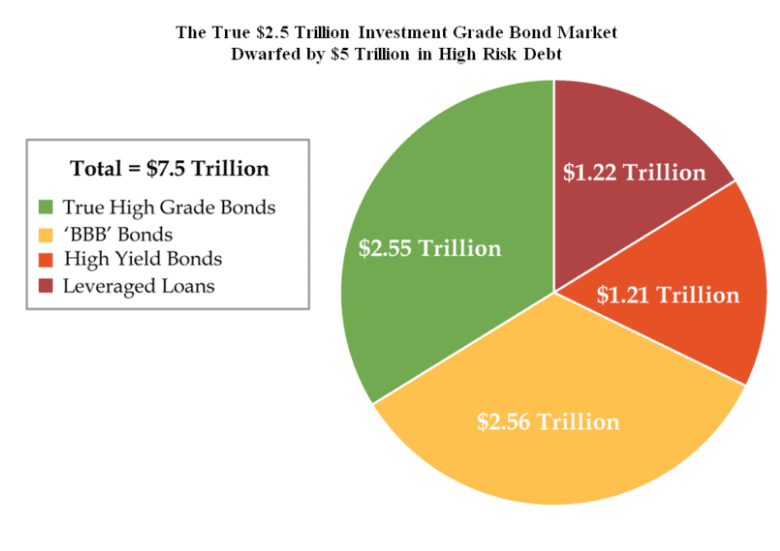
    Now there are a lot of companies out there who have done similar things, but are not anywhere near as stable as Apple.  In fact, there are trillions of dollars of bonds with the triple B rating rather than Apple’s AA+ rating.


    Market size of BBB Rated bonds (yellow) vs High Yield bonds (orange). [From Bloomberg]
    The ratings are important because “investment grade” bonds must have four ratings:  AAA, AA, A, BBB. Anything below BBB is not investment grade and is therefore a “high-yield” bond.


    Here’s why these ratings matter and why the investment universe has become nervous.  If a corporate, investment grade bond fund owns a bond that is no longer investment grade, then the fund MUST sell it.  Investment grade bond funds are only allowed to own investment grade bonds. All the popular bond funds (like the Vanguard Total Bond Market ETF (symbol BND) and the iShares Core US Aggregate Bond ETF (symbol AGG)) are investment grade funds.   Basically everyone owns these types of funds in their 401(k).


    The AGG bond fund has been in a steady decline throughout 2018.

    If funds like these are forced to sell there could be huge problems.  The size of the BBB market is $2.5 trillion dollars according to Bloomberg.  But the size of the junk bond market is only $1.2 trillion dollars. It is impossible for the junk bond funds to be able to buy all the bonds that the investment grade funds could be forced to sell.  There is only one outcome. Massive price declines! I haven’t seen any estimates on how much this scenario would affect the price of popular bond funds, but suffice it to say that it would be huge.


    With these worries about bonds taking huge hits, and the high valuations from large stock market returns over the past ten years, decision makers have decided to pause their buying of stocks and reduce their risk.  Hence the current stock market sell off.

  • The Folly of Stock Market Predictions

    The Folly of Stock Market Predictions

    Happy New Year, and welcome to market prediction season!  At this time of year, every Wall Street firm and business magazine puts out their predictions for the stock market’s upcoming year.  After much analysis and secret sauce, they come up with a final number for the value of the S&P 500 and the Dow 30 indexes on December 31, 2018.

    Should we believe them?  No.  Is it worth reading the articles about these predictions?  No.

    There is a certain amount of hubris exhibited by these firms, believing they can predict the future.  They like to believe that intellect and analysis gives them a level of control, and with this control, they can foretell what will happen in the future.  What they are really doing is guessing.  No matter how many calculations are done, it is still a guess about the unknowable future.

    At Andrew Marshall Financial, LLC we believe the future of the markets cannot be predicted.  The possibilities of what could happen today, let alone any time in the next year, are just too broad.  It is a waste of time and energy trying to make these predictions.  Do yourself a favor and don’t read these types of articles.

    Furthermore, there is no reason to base an investment decision on someone’s guess about the future.  It is far better to invest using a system that has been proven to work.  A system that rather than predicting, establishes expected returns and is diversified using the best in class fund for each asset.

  • Top 8 Summer Destinations 2017 by Foreign Exchange Rate

    Top 8 Summer Destinations 2017 by Foreign Exchange Rate

    With summer approaching, now is a good time to compile a list of the top vacation destinations for the Summer of 2017. This list is unlike any other, however.  Rather than finding you the hip and trendy places being promoted by tourism bureaus, our destinations give you bang for your buck.  We ranked these destinations by how much cheaper they are this year, compared to last year, based on the US dollar exchange rate.

    The US dollar has been getting stronger over the past few years.  This is a great thing for American travelers going abroad. Other currencies have been struggling, like the British pound, after the Brexit issue.  This creates opportunities for Americans because when we exchange our dollars, we get more of the local currency in return.  This leads to a cheaper vacation.

    Here are the top destinations:

    Travel Rankings Apr 17
    Exchange rate percentage change for 1 USD between April 30, 2016 and April 19, 2017.

    These rankings tell us a trip to Britain, Scandinavia or Eastern Europe would be the best value this summer. Alternatively, both Canada and Mexico offer good alternatives if you want to stay closer to home.

    Those of you who want to go to Europe (all Euro currency countries) will be happy to know that Europe is 5.9% cheaper than last year.  It would be a good value to go to Europe and combine those countries with Scandinavia or Eastern Europe.

    Safe travels to all of you this summer.


  • Social Security Payments

    Social Security Payments

    Will your Social Security payments cover your retirement lifestyle? Do you plan to rely on Social Security for most of your retirement income?

    Most people have no idea how their future social security payments compare with their current income. If you are thinking you can retire in five years or less, make sure you log on to ssa.gov and look at your Statement. Your Statement will give you an estimated monthly benefit payment that you have accumulated. This is what you would get if you retired tomorrow. Is it as much as you were expecting?

    I doubt it. I find people vastly underestimate the amount of money they will get from Social Security. This can have a dramatic effect if you are approaching retirement and expecting a larger amount than you are due. If you are counting on Social Security to provide a large portion of your retirement income, think again.

    Social Security was designed as a safety net to provide the poorest Americans with food and shelter in their old age. Social Security is not an income replacement program or a retirement plan for the masses. It is an anti-poverty program. Those who have middle to high incomes will not receive anywhere near their current income from Social Security.


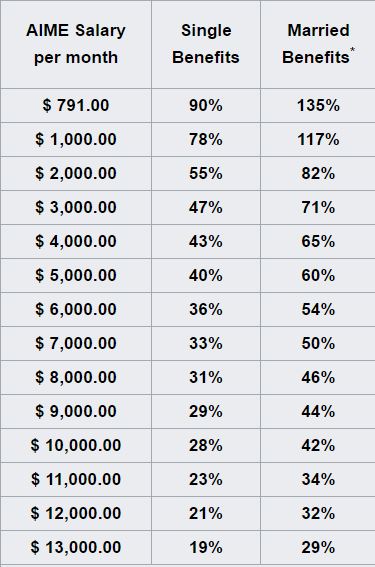
    aime jpgThe chart at left shows the average indexed monthly salary (AIME) and the corresponding percentage of that salary that will be received from social security. The average indexed monthly salary takes your highest 35 years of salary and indexes each year for inflation so that your early years of work are given the same weight as recent years. That doesn’t mean you can look at the chart and see what you are making now and look to see the percentage.

    Most people’s salary has progressed over their career, but some people have low or non-earning years if they left the workforce to raise kids for example. These lower year’s decrease your average. In order to get an estimate on what your average is, you have to go online to My Social Security.

    Let’s look more closely at the chart numbers again and examine two scenarios. Someone who has had a good paying job and has an AIME of $8,000 per month (about $100,000) per year will have a payment of 31%. That’s 31% of 8,000 per month. Or $2,480. If this person is relying on Social Security to cover their retirement expenses, they are in for a challenge. It is really hard to change your lifestyle from living on $8,000 per month to $2,480!

    I mentioned earlier that Social Security is really a program to keep people out of poverty. The poverty level for a single person is $11,880 per year. Let’s call it $1,000 per month. Someone earning $1,000 per month would receive $780 per month from Social Security. Now it would be hard to live on that amount, but it would not be as big of a change from $1,000 to $780 per month as the change would be from $8,000 to $2,480.

    This issue of Social Security payments being smaller than expected is one of many reasons it is a good idea to talk to a fee only financial planner as early as possible. By monitoring your financial situation and working with a fee-only financial planner for many years leading up to retirement, low Social Security payments won’t come as a shock.

    To retire comfortably, you need other sources of income. It is important to work somewhere that provides a pension, 401(k) or other retirement savings, so you are forced to contribute before it is too late. If there are no other retirement savings, then there may be no choice for retirement other than working longer and experiencing a major lifestyle change. Neither of which are much fun.


  • What are Social Security Survivors Benefits?

    What are Social Security Survivors Benefits?

    Social Security Survivors benefits are paid to widows, children, parents and ex-spouses of covered workers.

    The Social Security program actually consists of three benefit programs that make payments for various reasons. They are:

    1. Retirement benefits,
    2. Disability benefits,
    3. Survivors benefits.

    This post covers number 3, Survivors benefits. These are not the same as the benefits commonly referred to as spousal benefits.


    mother and child

    If a worker, who is covered by Social Security, dies and leaves family members behind, they are the “survivors” and are covered under the Survivors benefits program. Social Security will use the deceased worker’s record to calculate payments for his / her family.

    There are four eligible parties that may receive payments after the worker’s death. They are the widow (or widower if the wife dies first), children, parent, and ex-spouse. Each has detailed rules for eligibility.

    A widow(er) will get benefit payments if:

    • They are age 60+, or
    • Age 50+ and disabled, or
    • Any age and caring for a worker’s child under 16 or disabled and entitled to benefits on worker’s record.

    A child will get benefit payments if:

    • They are under age 18, or
    • Between 18 and 19 and still in secondary school, or
    • Over age 18 and severely disabled before age 22.

    A parent will get benefit payments if:

    • They are dependent on the deceased worker for greater than 50% of their support

    An ex-spouse will get benefit payments if:

    • They fit one of the three requirements for widow(er) above and were married to covered worker for 10 or more years, and
    • They are not entitled to a larger benefit based on their own record, and
    • Not currently married unless marriage was after they turned 60 or 50 and are disabled.

    Another aspect of Survivors benefits that comes into the payment amount is that the “full retirement age” (FRA) for Survivors benefits is different from the full retirement age for retirement benefits.


    Birth YearSurvivors FRARetirement FRA
    1937 or earlier6565
    19386565 and 2 months
    19396565 and 4 months
    194065 and 2 months65 and 6 months
    194165 and 4 months65 and 8 months
    194265 and 6 months65 and 10 months
    194365 and 8 months66
    194465 and 10 months66
    1945-546666
    19556666 and 2 months
    19566666 and 4 months
    195766 and 2 months66 and 6 months
    195866 and 4 months66 and 8 months
    195966 and 6 months66 and 10 months
    196066 and 8 months67
    196166 and 10 months67
    1962 or later6767

    This chart matters because a widow(er) or ex-spouse can start claiming benefits as early as age 60, but the benefit will be reduced. For the full benefit payment, the survivor must wait until their FRA in the center column above. For some people it is several months earlier than the full retirement age for Retirement benefits and they may wait unnecessarily long to receive their benefits if they are unaware of this anomaly in the Social Security benefits.


  • Health Savings Account Contributions Calculations

    Health Savings Account Contributions Calculations

    Health Savings Accounts (HSA) are a smart way to establish an extra source of funds you can tap into to cover medical expenses later in life.  You can use the funds immediately, but the true benefit comes after giving the account a chance to grow.  HSAs are accounts, held by a custodian such as a bank, whose withdrawals (including the gains from investing the savings) are tax free if used for health care expenses.  By taking advantage of these accounts, the government hopes citizens will be better able to cover the future costs of health care.  We all know medical costs are increasing quickly, and we have heard the stories about people who are forced to spend down all or most of their retirement savings to cover their health care costs.  A health savings account should provide you with an extra layer of protection in the future.

    First question is, who is eligible for an HSA?  1. You cannot be claimed as a dependent on someone else’s tax return.  If they could claim you but don’t, then you are not eligible. 2. You cannot be on Medicare. 3. You must be covered by a High Deductible Health Plan (HDHP) and no other plan on the first day of the month. (There are of course exceptions, but these are mostly for additional plans that do not pay before the HDHP deductible is reached.)

    Second question is how much can someone contribute to their HSA in 2016?  The contribution limits for 2016 are $3,350 for someone with self-only HDHP coverage and for a family with HDHP coverage the max is $6,750.  These amounts are the maximum for someone with qualifying health insurance and HSA eligibility each and every month of the year.  Some people aren’t eligible every month of the year, and they need to do a calculation to determine how much their maximum is.  Contributing more than your maximum allowed and not correcting the mistake will lead to a 6% excise penalty.

    Additional Contribution: Those eligible individuals who are 55 years of age and older at the end of their tax year are allowed to contribute an extra $1,000.

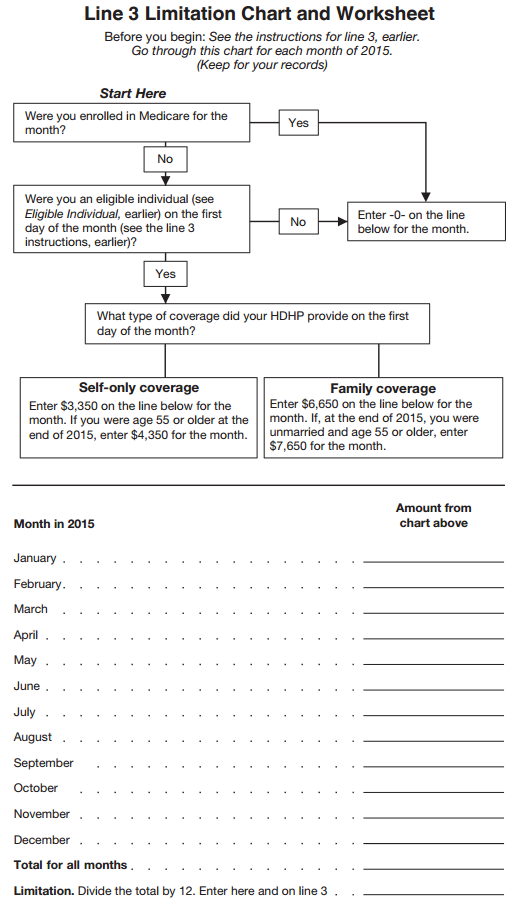
    IRS Form 8889 WorksheetThe last-month rule is a shortcut determination used to determine if you are eligible to contribute the maximum amount.  The last-month rule states that a person who is eligible to contribute to an HSA on the first day of the last month of their tax year is treated as being eligible the entire year.  The day used for determination is December 1 for most people.  So if you meet the requirements on December 1, you can contribute $3,350 for a single person or $6,750 for a family.

    What if I wasn’t covered in the last-month?  You must use the “Line 3 Limitation Chart and Worksheet” found in the instructions pdf for IRS Form 8889.

    Putting money away in a Health Savings Account is a good idea if you are eligible for one.  Many employers are now offering it as an alternative to HMO medical coverage.  Be sure to calculate your maximum allowed to avoid paying penalties.


  • Importance of Later Years

    Importance of Later Years

    GradCapsYesterday I answered a press request asking about when is the best time to start saving for retirement. The standard answer is as early as possible. This comes from the idea that having more years to compound your returns will lead to a bigger account. I argue it’s the years at the end that are more important than the early years.

    First let’s review the power of compounding. When you invest money and earn a return, your account is worth more at the end of the year. In the second year, you earn return on a larger amount than the first year because your beginning balance in year two is the original year one principal plus the year one return earned. Each successive year will see larger gains as return is earned on a larger starting amount. The account will continue to grow even without new additions.

    When young people finish school and start working around age 22, they usually are not making a significant salary. This leaves them little extra money available for saving. If someone starts with saving $100 per month or $1200 per year, and earns 7%, then how much will they have after five years? My financial calculator tells me it’s $6,900.

    This person did the “right thing” and started early in their retirement savings. I would argue that saving this much by age 27 is not crucial to retirement. A large contribution in year six can easily make up for the first five years. It’s not necessarily how early you start, but a combination of how much is saved and for how many years.

    Now we look at return at the beginning of the 30 year time frame versus at the end. When this example person is 28 years old and in year six of compounding, a 7% return on the $6900 they struggled to accumulate over five years will return $483. At the end of the compounding years however, when the account value is say $1,000,000, then he/she will make $70,000 return in one year. Just one additional year at the end brings another $70,000 versus $483 at the beginning.

    As this person progresses in their career, they will receive pay raises and move up the corporate ladder. Using these pay raises wisely will have a more significant impact on their retirement than saving as early as possible. Staying invested at 7% for three additional years at the end of their career will turn a $1,000,000 portfolio into a $1,225,043. Twenty-two percent more savings for retirement. See the importance of the later years?

  • Financial Planner as Consultant

    Financial Planner as Consultant

    ClappingOn my blog, one of the topics I like to cover is explaining how the personal financial advice industry works. Most people get financial advice from someone who is a salesman of insurance, annuities, mutual funds, and other products. You can also get help from someone whose main profession is something related like a CPA or lawyer who offer advice as a side business. The best way to get advice however, is from someone who functions as a consultant.

    There are financial advisors out there that charge by the hour for financial advice. They often call themselves financial planners to distinguish themselves from financial advisors. You can find these financial planners through industry associations like the Garrett Planning Network and Fee Only Network.

    I say it’s best to work with a consultant style of advisor because the consultant works only for you. Ask yourself what someone’s motivation is. A financial advisor employed by an insurance company or investment company (like Merrill Lynch, Morgan Stanley, Fidelity, Vanguard, etc.) has sales managers above them making sure they sell a certain number of contracts every month. You don’t want to be one of those sales targets. It may work out for you, and there are representatives who do look out for their clients, but ask yourself what their motivation is before signing anything.

    By hiring a financial planner that charges fees only and no commissions, you are going to get an advisor who puts your best interest ahead of their own. Ask the advisor to sign the fiduciary oath. Advisors out to meet sales performance targets won’t put their fiduciary duty in writing. By going with a consultant style of advisor, not only will you get sound financial advice, you won’t wonder if the advisor recommended a product because his sales manager told him to.